
Dead premium is the portion of insurance spend that doesn’t deliver proportional economic value. It’s capital transferred to insurers that could otherwise be retained, invested, or deployed within the business.

Capvartis
Published :
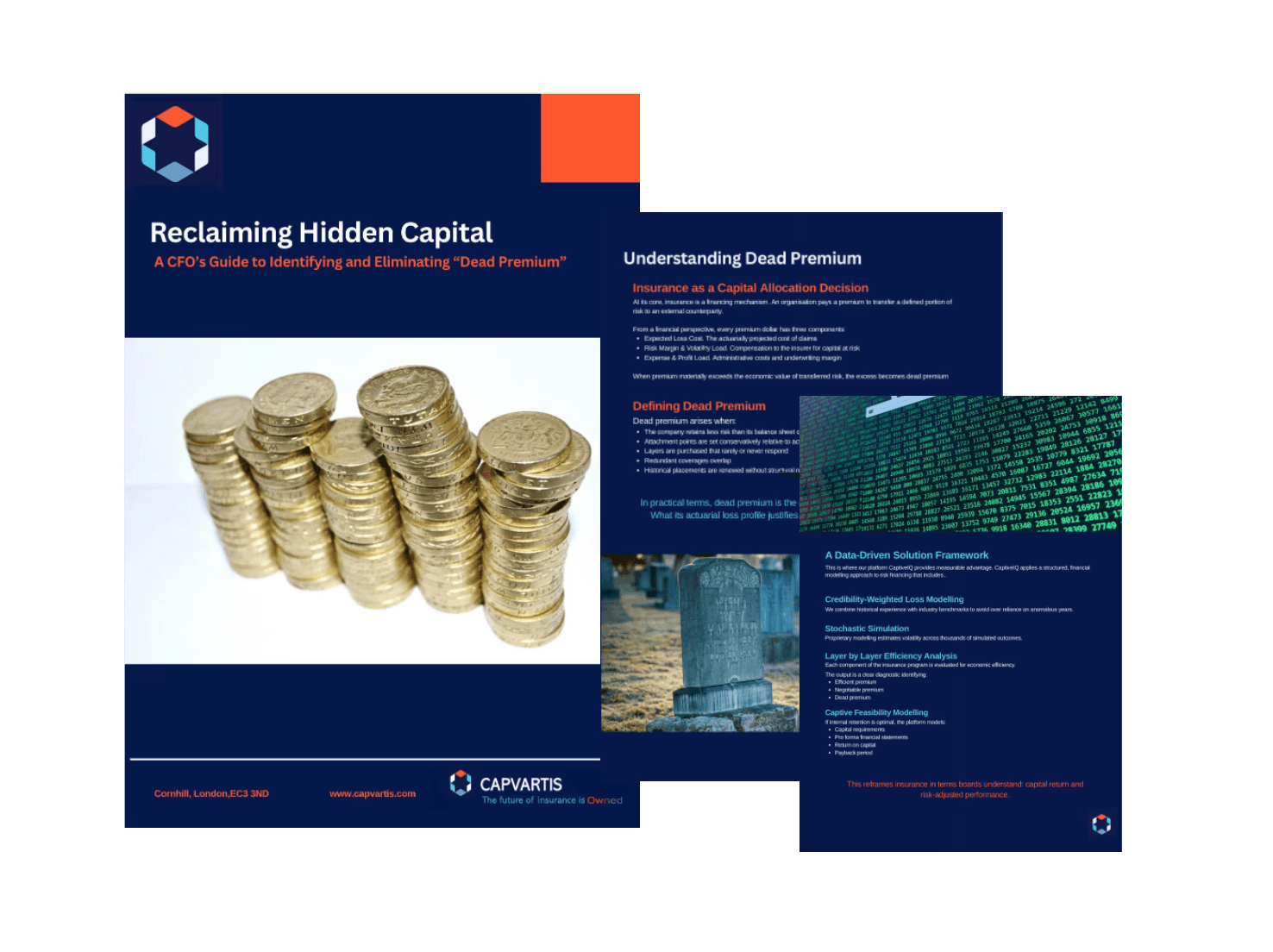
Reclaiming Hidden Capital: The Cost of “Dead Premium”
Insurance is one of the largest recurring expenses on a company’s income statement yet it’s one of the least scrutinised.
For many organisations, premiums are treated as a fixed cost of doing business. Renewed annually. Adjusted incrementally. Rarely challenged from first principles.
But beneath the surface, there’s a significant and often overlooked inefficiency: dead premium.
Dead premium is the portion of insurance spend that doesn’t deliver proportional economic value. It’s capital transferred to insurers that could otherwise be retained, invested, or deployed within the business.
Over time, this inefficiency compounds.
It builds through legacy program design, conservative risk retention, overlapping coverages, and market cycles that push costs upward faster than underlying risk. The result? A quiet but persistent drag on earnings, cash flow, and enterprise value.
The issue isn’t whether insurance is necessary.
It’s whether capital is being allocated efficiently within your risk financing strategy.
Forward thinking CFOs and boards are starting to rethink this. Instead of viewing insurance purely as a cost, they’re treating it as a capital allocation decision one that can be optimised.
📖 In our latest whitepaper, we break down:
✅ What dead premium is and why it accumulates
✅ How it impacts earnings, cash flow, and enterprise value
✅ How leading companies are restructuring risk to reclaim that capital
Download here 👉 https://www.capvartis.com/whitepaper/whitepaper-dead-premium